Passing the Basic RPAS Operator Certificate exam from Transport Canada is the first real milestone for anyone planning to fly a drone for pay in Canada, whether you want to deliver commercial drone services solo or join a larger operation. The exam has 35 multiple choice questions, you need 65% to pass, and you get 90 minutes. If you walk in cold, you will fail. If you study with the right plan, most people pass on the first try. This guide pulls together the Transport Canada basic drone exam study tips we share with every student who walks into our Toronto ground school, so you can prepare smart instead of cramming hard.
What the Basic Exam Actually Tests
The Basic RPAS exam covers nine knowledge areas mapped to the official Transport Canada Knowledge Requirements for Pilots of Remotely Piloted Aircraft Systems, document TP 15263. The big four that trip people up are air law, airspace classification, meteorology, and human factors. The other five (navigation, radio communications, flight operations, RPAS systems, and theory of flight) reward steady study but are less ambiguous.
Read the Knowledge Requirements document yourself at Transport Canada’s official site. It is the exact blueprint the exam writers work from. Most people skip this step and study some random third-party course instead, which is one reason the Transport Canada basic drone exam study tips that actually work all start with the official document.
Transport Canada Basic Drone Exam Study Tips That Actually Move the Needle
These are the habits that separate a first-try pass from a third-try retake.
- Study in 45 minute blocks. Two solid blocks a day for two weeks beats one eight hour Saturday cram every time. Spaced repetition is real.
- Use the official study guide as your spine. Build a one page summary for each of the nine knowledge areas. If you can teach the topic in three sentences without notes, you know it.
- Memorize the airspace classes cold. Class A, B, C, D, E, F, G. You need to know what each one looks like on a VNC and what permission you need to fly there. The exam loves this section.
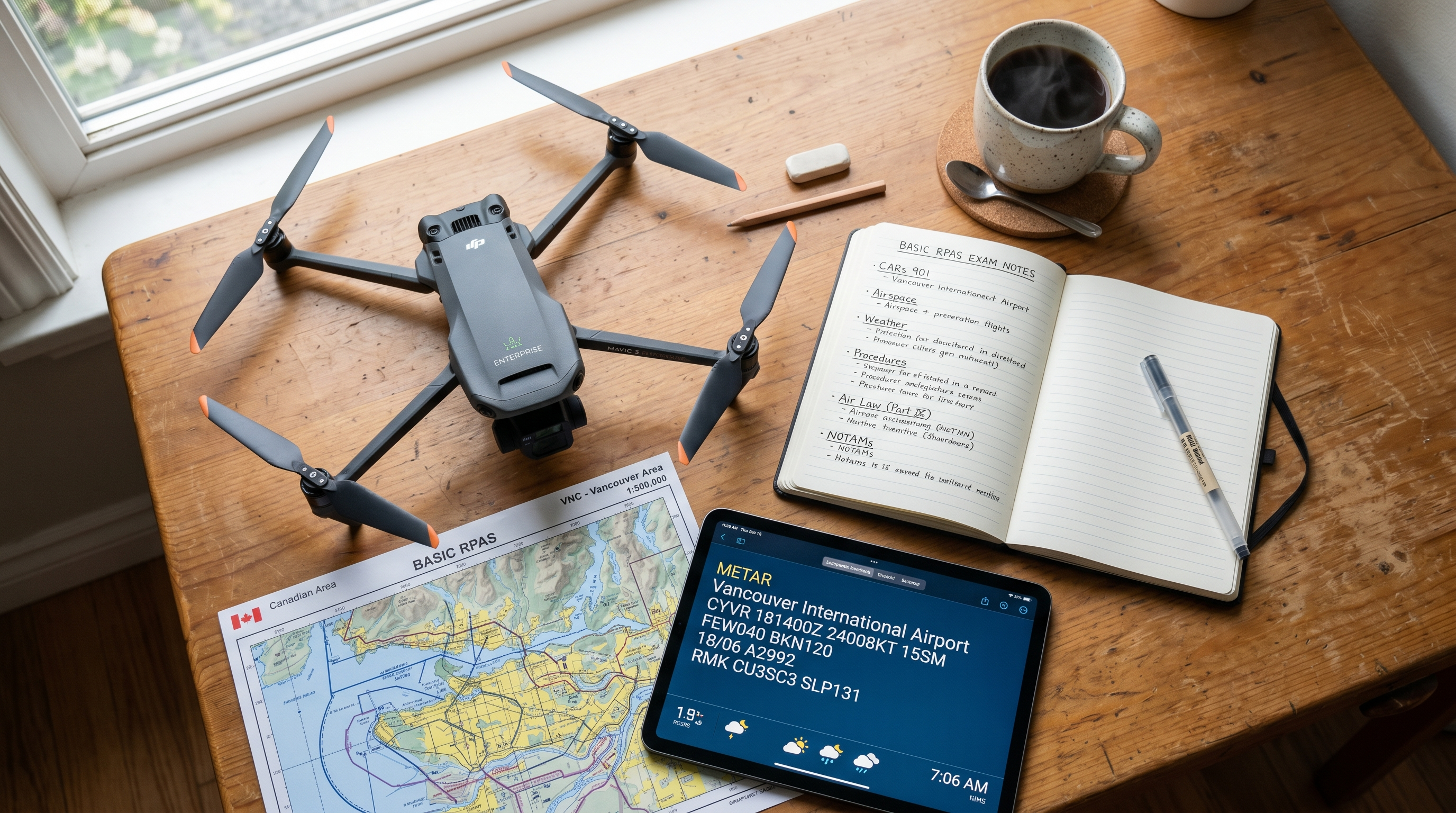
- Practice reading a METAR and a TAF. Roughly six to eight questions on every exam are weather decoding. If you can read these two reports fluently, you bank those points.
- Take at least three full mock exams before the real one. Time yourself. The 90 minute clock catches people off guard.
The Nine Knowledge Areas, Ranked by Exam Weight
Air Law and Regulations
Around 30% of questions touch air law. Memorize the difference between Basic and Advanced operations, the maximum altitude (122 m AGL, or 400 ft), the 5.6 km no-fly zone around uncontrolled airports for Basic operators, the 1.9 km buffer from heliports, and the requirement to keep your drone in visual line of sight at all times. Know that flying over bystanders is what bumps an operation from Basic to Advanced.
Meteorology
You will get METAR and TAF decoding questions. Print a METAR cheat sheet, drill the abbreviations until they are reflex, and learn the visibility and ceiling minimums for VFR operations. Density altitude shows up too.
Navigation and Charts
The VNC, or VFR Navigation Chart, is critical. You should be able to identify control zones, restricted airspace (CYR), advisory areas, obstacles, and airspace boundaries from chart symbols alone. Pull up a free VNC at NAV CANADA and practice for an hour.
RPAS Systems, Theory of Flight, Flight Operations, Radio, Site Survey, Human Factors
These each carry less individual weight but together make up half the test. They are also the easiest content to learn, so do not skip them to chase the harder topics. Easy points are still points.
Why Mock Tests Are the Best Transport Canada Basic Drone Exam Study Tips
Free practice tests exist on Drone Pilot Canada, Coastal Drone, and a handful of YouTube channels. Pay for one good question bank with detailed answer explanations. The act of getting a question wrong and reading why you were wrong is where the real learning happens. Three mock exams under timed conditions is a baseline. Five is better. The Transport Canada basic drone exam study tips above are useless without the practice volume to back them up.
What an In-Person Ground School Adds
You can pass the Basic exam with online study alone. Plenty of people do. The argument for an in-person ground school is speed and clarity. Twelve hours of structured instruction with an instructor who has flown commercially and trained other pilots compresses what would otherwise be a month of self-study into a single weekend. SkyTech runs Transport Canada drone pilot training out of our Toronto facility, including the Basic curriculum, hands-on flight time, and access to certified Flight Reviewers who can administer the flight review when you upgrade to your Advanced certificate later.
For pilots planning to do paid work, the training also doubles as practical exposure to the operational reality of professional drone work. Knowing the regulatory framework cold is what separates pilots who get hired from pilots who just have a certificate sitting in a drawer.
Exam Day Logistics and Last Minute Transport Canada Basic Drone Exam Study Tips
You take the Basic exam online through your Drone Management Portal account on the Transport Canada site. You will need a valid email, a credit card for the $10 fee, and a quiet room. The exam is not proctored, but you must answer honestly. Cheating risks your certificate and your right to fly.
Practical tips for the day:
- Sleep at least seven hours the night before. Decision fatigue questions become much harder on three hours of sleep.
- Have your study notes open in another browser tab. The exam allows you to reference materials, but if you have to look up every answer you will run out of time.
- Read every question twice. Trick wording, especially around airspace and weather minimums, is the number one cause of avoidable wrong answers.
- If you are unsure, flag the question and move on. Come back at the end with whatever time is left.
- You need 23 of 35 correct, which is 65%. Do not waste 20 minutes on one tricky question.
What to Do After You Pass
Print your Pilot Certificate immediately. Carry it (a digital copy on your phone is fine) any time you fly. Register every drone over 250 g and under 25 kg with Transport Canada and mark the registration number visibly on the airframe.
The Basic certificate covers you for uncontrolled airspace operations more than 30 m horizontally from bystanders, away from airports, under 122 m AGL. The moment any of those conditions break, you need the Advanced certificate, which requires a flight review with a certified examiner in addition to a tougher written exam. If you plan to do roof inspections, real estate aerial work, construction site mapping, or any urban operation, you will need the Advanced. Plan that path early so the timeline does not catch you off guard.
Common Mistakes That Undo Your Study Plan
The Transport Canada basic drone exam study tips above only work if you avoid the most common errors:
- Memorizing instead of understanding. The exam paraphrases the source material. If you only memorize sample questions, you will fail when the wording shifts.
- Skipping the boring topics. Human factors and radio comms feel low yield. They are not. Each one can be worth two or three questions.
- Studying once and waiting weeks to take the exam. Knowledge decays fast. Study, then book and take the exam within a week of finishing.
- Ignoring weather. Six to eight questions on weather is too many to leave on the table. Drill METAR and TAF until you can read them at a glance.
Final Thoughts
The Basic RPAS exam is not difficult if you respect it. The Transport Canada basic drone exam study tips that consistently produce first-try passes come down to three things: study the official Transport Canada Knowledge Requirements document, drill weather and airspace until they are reflex, and take at least three full timed mock exams. Most people who fail did not do those three things. Most people who pass did.
If you want a faster, more structured path with hands-on flight time, in-person instruction, and certified Flight Reviewers under one roof, book a free consultation with our training team. We will walk you through the right program for your goal, whether that is a single Basic certificate, the Advanced path for commercial work, or a full transition into professional drone operations.
Ready to Take the Next Step?
Whether you need drone pilot certification, a custom engineered solution, help navigating Transport Canada permits, or a professional drone service for your next project, Mostavio-SkyTech is your trusted partner in Canada.
Contact us today for a free consultation and let’s build something great together.