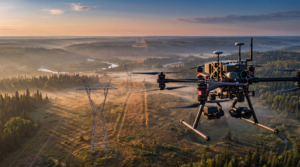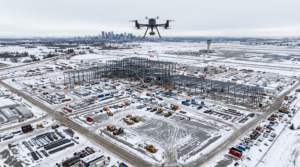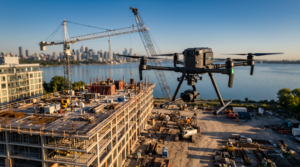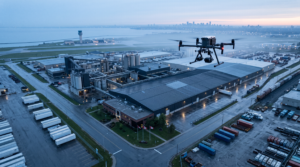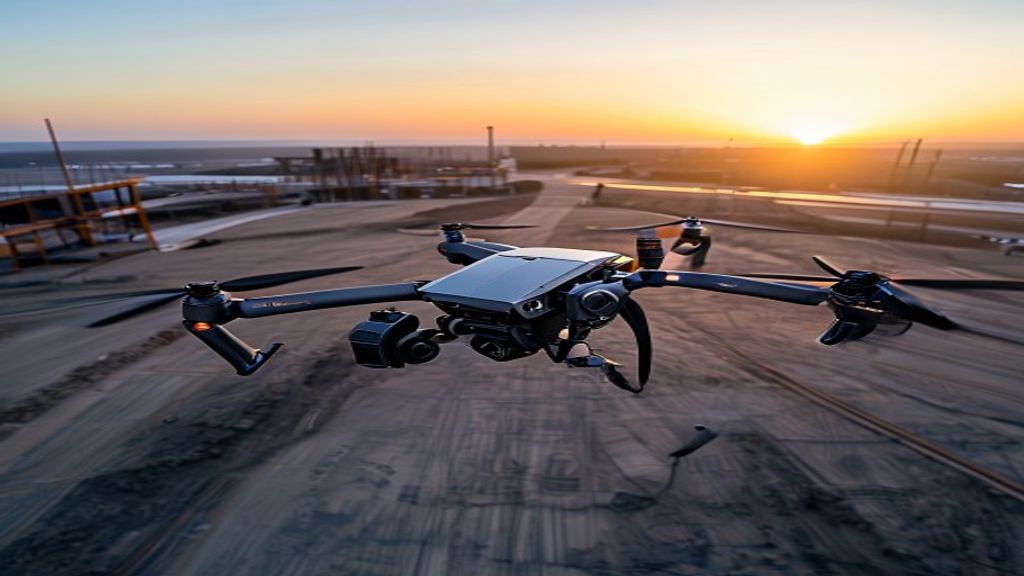
If you are weighing the DJI Matrice 350 RTK for enterprise work, here is the short answer. It is one of the most capable industrial drones you can buy in Canada today, and it earns its price on inspection, mapping, and public safety jobs. It is also heavy, costly once you add payloads, and only a modest step up from the M300 RTK it replaced. This DJI Matrice 350 RTK review Canada operators can actually use starts with the numbers, then gets honest about who should buy it and who should not.
We fly these on real jobs, so this is not a spec sheet rewrite. A useful DJI Matrice 350 RTK review Canada buyers can trust has to answer three things. What does the aircraft do well? Where does it fall short? And what does it cost to run legally under Transport Canada rules? That is what you get below. If you need help scoping a fleet or a single airframe for your operation, our team runs commercial drone services across the country and sees this platform on live sites every week.
What This DJI Matrice 350 RTK Review Canada Covers
The Matrice 350 RTK is DJI’s flagship industrial quadcopter. It launched in 2023 as the successor to the M300 RTK. Think of it as the truck of the DJI enterprise lineup. It is built to lift professional sensors, fly long missions, and keep working in bad weather. It is not a mapping first mini like the Mavic 3 Enterprise. It is a heavy lift platform for teams that need serious cameras in the air.
The headline changes over the M300 are a new RC Plus controller, upgraded TB65 batteries, DJI’s O3 Enterprise video link, and a redesigned arm with an FPV night camera. The airframe, flight time, and payload capacity stay close to the old model. That matters for your buying decision, and we cover it in the upgrade section below.
Matrice 350 RTK Specs That Actually Matter
Here are the numbers that change how you plan a job. The Matrice 350 RTK flies up to 55 minutes on a charge with no payload. Add a heavy sensor and real working time drops to roughly 30 to 40 minutes, which is still strong for this class. Maximum payload is 2.7 kg, and the aircraft can carry up to three sensors at once within that limit. It weighs about 6.5 kg with two batteries, with a maximum takeoff weight of 9.2 kg. The IP55 rating and a -20°C to 50°C operating range mean Canadian winter work is genuinely on the table. It handles wind up to 12 m/s, about 43 km/h.
The TB65 batteries are dual and hot swappable. You pull one at a time and the aircraft stays powered, so battery changes take seconds instead of a full shutdown. The RC Plus controller has a bright 7-inch screen you can read in direct sun. The O3 Enterprise link pushes triple channel 1080p video out to a claimed 20 km. You will rarely fly that far under Canadian rules, but the margin gives you a rock solid signal at normal ranges. Any honest DJI Matrice 350 RTK review Canada crews rely on has to say the transmission is a real step up from the old system. You can cross check the full figures against DJI’s official enterprise specs before you commit.
Payloads and RTK Accuracy
This is where the platform earns its keep. The Matrice 350 RTK works with the Zenmuse H20 series, the P1 full frame photogrammetry camera, the L2 LiDAR unit, and the newer H30T. The onboard RTK delivers centimeter level positioning, rated at 1 cm plus 1 ppm horizontal and 1.5 cm plus 1 ppm vertical. In plain terms, your maps and models land in the right place without laying hundreds of ground control points. On a mid size construction site that can save several hours of survey work per visit.
The DJI Matrice 350 RTK Review Canada Buyers Actually Want
Start with the strengths. Build quality is excellent and the IP55 rating holds up in rain and dust. Flight time is class leading. The payload ecosystem is the widest in the industry, so one airframe covers thermal, zoom, mapping, and LiDAR. Six direction obstacle sensing makes it forgiving near structures. Hot swap batteries keep downtime low on busy days.
Now the honest cons. It is expensive, and the cost climbs fast once you add a P1 or an L2. It is heavy at about 6.5 kg with batteries, so transport and setup take real effort. The 2.7 kg payload ceiling means you cannot fly every sensor combination together. The batteries and the charging station add cost and weight to your kit. If you already own an M300 RTK, the jump to the 350 is incremental, not essential. A fair DJI Matrice 350 RTK review Canada operators respect will not pretend otherwise.
Should You Upgrade From the M300 RTK?
For a lot of teams, the answer is no. The M300 RTK still flies the same core payloads and gets similar flight time. If your controller works and your batteries are healthy, you can keep running the older airframe for years. The M350 makes sense when you are buying new, expanding a fleet, or you want the brighter RC Plus controller and the stronger video link for beyond visual line of sight planning. Starting from zero, buy the 350. Sitting on a healthy M300, put the money into payloads or pilot training instead.
Flying the Matrice 350 RTK Legally in Canada
This is the part buyers skip and later regret. The Matrice 350 RTK weighs about 6.5 kg, so it sits in the 250 g to 25 kg category. You must register the aircraft with Transport Canada and mark it with your registration number. The pilot needs a valid RPAS certificate. For most enterprise work near people or in controlled airspace, that means the Advanced certificate, not Basic. You can read the current rules straight from Transport Canada before you fly.
Confirm the aircraft’s safety declaration for the operations you plan, because advanced operations depend on it. If your crew is not certified yet, factor that time and cost into the purchase. A complete DJI Matrice 350 RTK review Canada pilots trust has to cover the paperwork, not just the flight specs. We stock DJI enterprise drone products and run the training path alongside them, so you can sort the airframe and the licence together.
Price and Where to Buy
Pricing moves with configuration, so plan realistically. A Matrice 350 RTK aircraft with the RC Plus controller and a set of TB65 batteries lands in the range of roughly CAD $14,000 to $16,000. Payloads are separate. A Zenmuse P1 adds around CAD $9,000. Add an H20T thermal zoom camera or an L2 LiDAR and a full kit pushes well past CAD $30,000. Budget for the battery station, spare propellers, and a hard case too.
Buy from an authorized DJI enterprise dealer, not a grey market reseller. Enterprise gear needs proper warranty support, firmware access, and a real person to call when a payload acts up on a job. As an authorized dealer, we handle the airframe, the payload match, and the after sale support in one place. If you want a straight recommendation for your use case, book a free consultation and we will spec it with you.
Final Verdict
Here is the bottom line of this DJI Matrice 350 RTK review Canada teams can act on. The Matrice 350 RTK is the right buy if you need a rugged, long endurance platform that carries professional sensors and works through a Canadian winter. It is the best all round industrial drone DJI makes today. It is the wrong buy if your work fits a smaller mapping drone, or if you already run a healthy M300 RTK that does the job. Match the tool to the mission and the numbers make sense.
If you are still comparing options, that is normal, and it is smart to do before you spend five figures. Use this DJI Matrice 350 RTK review Canada buyers can trust as a starting point, then talk to an operator who actually flies the platform. That last step is where a good purchase gets locked in.
Ready to Take the Next Step?
Whether you need drone pilot certification, a custom engineered solution, help navigating Transport Canada permits, or a professional drone service for your next project, Mostavio-SkyTech is your trusted partner in Canada.
Contact us today for a free consultation and let’s build something great together.