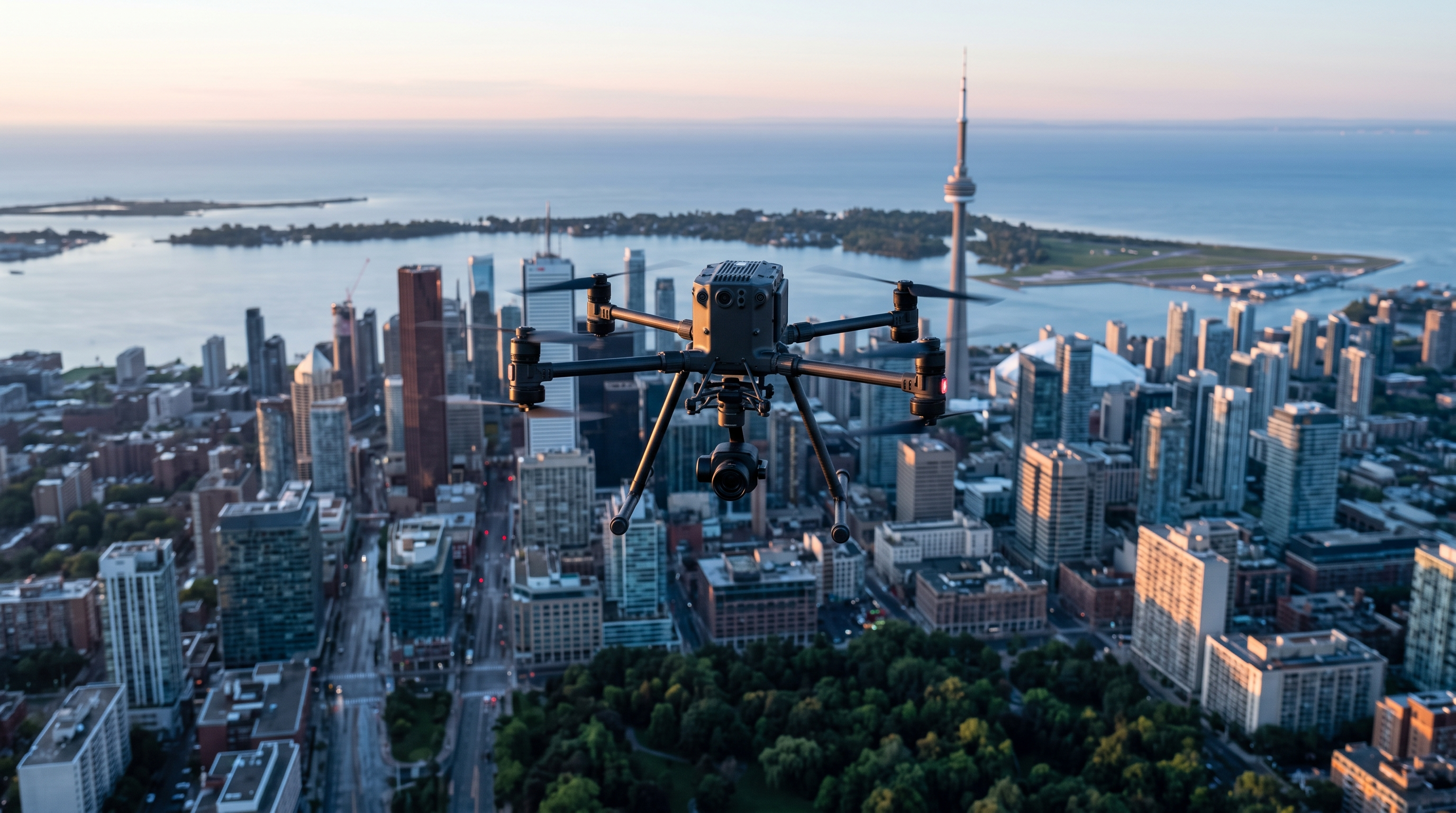
If you want to know how to fly drone in Toronto legally, the short answer comes in three steps. Register your drone with Transport Canada. Pass the right pilot exam. Get airspace authorization before you take off. Toronto sits under some of the busiest controlled airspace in Canada, so the rules here are tighter than they are in an open rural field. This guide walks through each step, so you can fly with confidence and stay on the right side of the law.
Drones in Canada fall under Part IX of the Canadian Aviation Regulations. Those rules took effect on June 1, 2019, and Transport Canada has amended them more than once since. As of the latest Transport Canada guidelines, any drone weighing between 250 grams and 25 kilograms must be registered and flown by a certified pilot. It does not matter whether you fly for a hobby or run full commercial drone services across the city. The weight of your aircraft and the airspace you fly in set the rules, not your reason for flying. Because the framework keeps evolving, confirm the current details on the official Transport Canada drone safety page before every season.
First, Register Your Drone
The first practical part of how to fly drone in Toronto legally is registration. You register each drone with Transport Canada for a $5 fee. Once it is approved, you receive a registration number. Mark that number on the outside of the aircraft where it is easy to read. Carry proof of registration on every flight, on your phone or on paper. Flying an unregistered drone in the 250 gram to 25 kilogram class can bring fines of up to $1,000 for an individual, so this step is not optional.
Drones under 250 grams sit in a lighter category. You do not need to register them or hold a certificate. You still cannot fly them recklessly, near airports, or anywhere close to a crewed aircraft. A sub-250-gram drone is the simplest way to start, but it is not a free pass to ignore safety.
Next, Get the Right Pilot Certificate
Once your drone is registered, you need a pilot certificate. Transport Canada offers two levels, and picking the correct one is central to how to fly drone in Toronto legally. The level you choose decides where you can fly, how close to people you can operate, and whether the airspace over your neighbourhood is open to you at all.
Basic operations cover flights in uncontrolled airspace, more than 30 metres horizontally from bystanders, and never directly over people. You earn this certificate with an online exam of 35 questions. It costs about $10, you need 65 percent to pass, and you must be at least 14 years old or supervised by someone who is certified.
Advanced operations cover flights in controlled airspace, closer to people, and near airports. You pass a harder online exam, then complete an in-person flight review with an accredited reviewer. You also need a drone with a manufacturer declaration that supports the operation. The minimum age is 16, or supervised.
Here is the key point for this city. Because so much of Toronto sits inside controlled airspace, most local pilots need the Advanced certificate, not Basic. Our advanced RPAS certification course prepares you for both the written exam and the flight review, so you are ready where the rules actually bite.
How to Fly Drone in Toronto Legally in Controlled Airspace
This is where Toronto gets complicated. Two airports shape the sky over the city. Toronto Pearson (CYYZ) is one of the busiest airports in the country. Billy Bishop (CYTZ) sits on the Toronto Islands, only minutes from the downtown core. Their control zones reach across a large share of the city, and heliports add more restricted pockets on top. Even suburban areas like North York, Scarborough, and Etobicoke can fall inside controlled airspace, depending on how close they are to an airport approach path. Never assume a spot is uncontrolled just because it looks residential.
To fly inside controlled airspace, you need two things: an Advanced certificate and authorization from NAV CANADA. You request that authorization through the NAV Drone tool at navcanada.ca before you launch. Some areas grant near-instant automated approval. Others need a manual review, so plan ahead. Knowing how to fly drone in Toronto legally means checking the airspace for every single flight, because a park that looks wide open can still sit inside a control zone.
How to Fly Drone in Toronto Legally Around People
Even with the right certificate and airspace clearance, a few hard limits always apply. Keep your drone below 400 feet (122 metres) above the ground. Keep it within your direct line of sight at all times. Do not fly in cloud, and do not fly at night without the proper lighting and equipment. Stay clear of other aircraft, and never fly over an emergency scene, a forest fire, or a police operation.
Distance from people matters too. Basic pilots must stay at least 30 metres back from bystanders. Advanced pilots can fly closer, or even over people, but only with a drone rated for it. You also need to keep well away from airports and heliports unless you hold authorization, and the NAV Drone map shows those zones clearly. Special rules apply at advertised events as well. Flying over a festival, a parade, or a sports crowd needs advanced privileges and, in many cases, extra authorization.
Federal rules are only one layer. The City of Toronto restricts drone launches and landings in its parks, and Parks Canada requires a permit inside national parks. Part of how to fly drone in Toronto legally is respecting the municipal and provincial rules that sit on top of the federal ones. When in doubt, ask the landowner for permission before you launch.
Flying a Drone Legally for Commercial Work
If you plan to earn money with your drone, the certification requirements are the same, but the expectations climb. Clients want liability insurance, often one to five million dollars in coverage. They want clean flight logs and proof of certification. For complex jobs, such as flying beyond visual line of sight or over a crowd, you may need a Special Flight Operations Certificate from Transport Canada on top of your Advanced certificate.
This is why many businesses hire a certified crew instead of managing compliance in house. A professional operator handles the paperwork, the airspace requests, and the insurance, so the client gets clean data without the regulatory headache. If your project sits in downtown Toronto, that experience is worth a great deal, because the airspace there leaves no room for guesswork.
A Pre-Flight Checklist for Flying Legally
Run through this short list before every flight, and how to fly drone in Toronto legally becomes second nature:
- Drone registered, with the registration number marked on the airframe
- The correct pilot certificate in hand, Basic or Advanced
- Airspace checked in the NAV Drone app for your exact location
- Authorization received if you are flying in controlled airspace
- Weather, wind, and battery levels confirmed as safe
- Bystanders, property access, and any park or event rules cleared
Six quick checks protect your equipment, the public, and your standing with Transport Canada.
The Bottom Line
Learning how to fly drone in Toronto legally comes down to three habits: register, certify, and check the airspace every time you fly. The city’s dense controlled airspace means most pilots here need the Advanced certificate and a NAV CANADA authorization, so build both into your routine from day one. Get the fundamentals right, and how to fly drone in Toronto legally turns into a question you only need to answer once.
If the rules still feel like a maze, or you need a certified crew for a real project, you do not have to work it out alone. You can book a free consultation and we will map the fastest legal path for your flight, your certification, or your next commercial job.
Ready to Take the Next Step?
Whether you need drone pilot certification, a custom engineered solution, help navigating Transport Canada permits, or a professional drone service for your next project, Mostavio-SkyTech is your trusted partner in Canada.
Contact us today for a free consultation and let’s build something great together.