Police agencies across North America are at a crossroads. For years, DJI drones dominated public safety operations — affordable, reliable, and easy to fly. But as governments crack down on Chinese-manufactured technology over data security concerns, many law enforcement agencies are scrambling for alternatives that can match DJI’s capabilities without the geopolitical risk.
This guide covers what’s happening, why it matters for Canadian agencies, and which NDAA-compliant drone platforms are earning serious attention from police and public safety teams in 2025 and 2026.
The push to move away from Chinese drones
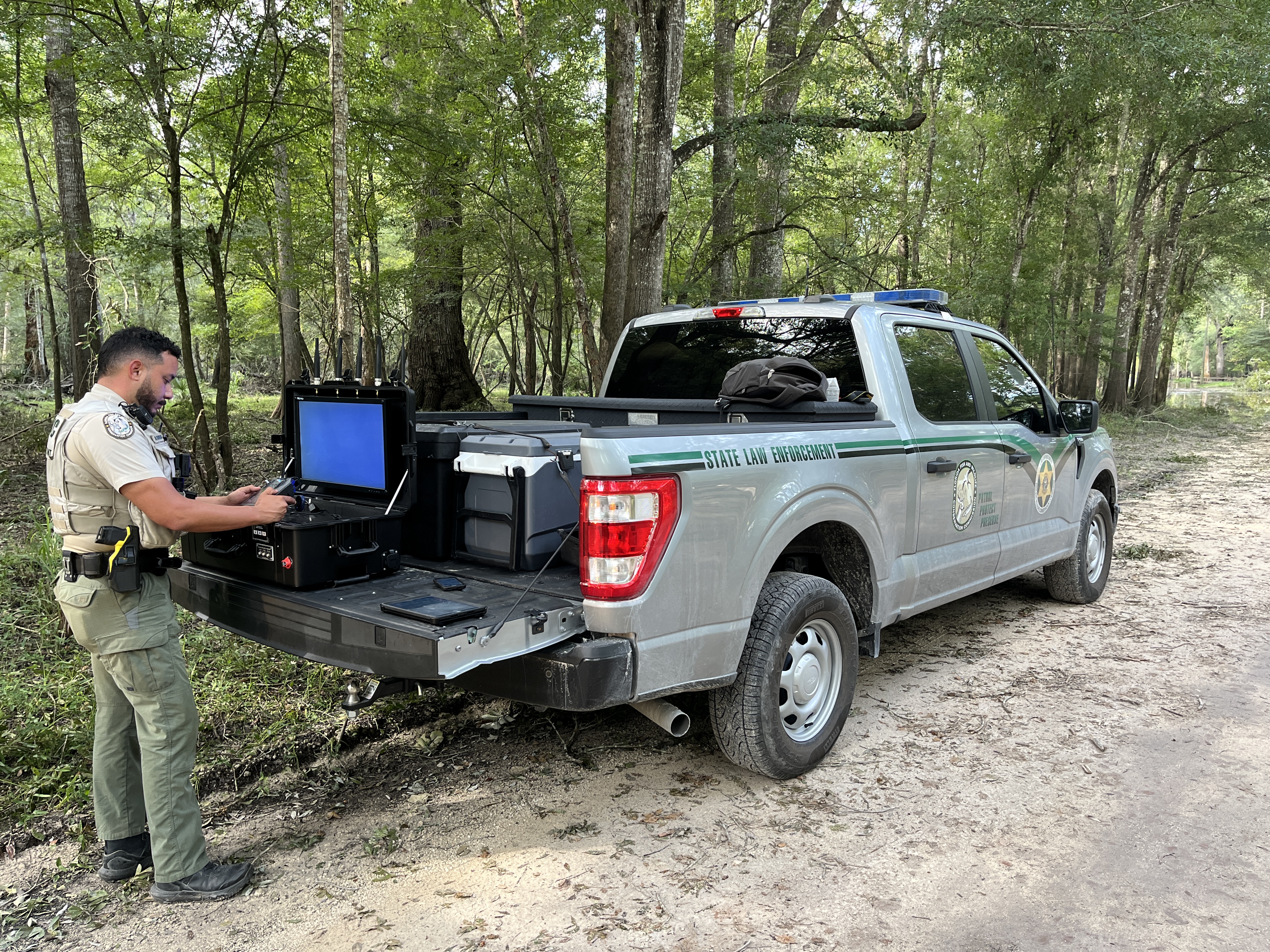
Security concerns around Chinese-manufactured drones have been building for years. U.S. officials have repeatedly warned that Chinese-made drones — particularly those from DJI — could potentially relay sensitive data to foreign servers, exposing operational details, personnel locations, and surveillance footage to unauthorized parties.
Florida enacted a statewide ban in 2023, and Tennessee now prohibits police departments from purchasing DJI equipment. At the federal level, the American Security Drone Act (embedded in the FY2024 NDAA) extended restrictions across every federal agency, every federal contractor, and every recipient of federal grants or cooperative agreements — including public safety departments receiving DHS funding. The two-year transition period ended December 22, 2025. Enforcement is now active.
Effective December 23, 2025, DJI and Autel Robotics were added to the FCC Covered List. This blocks both companies from receiving new FCC equipment authorizations and prohibits federal procurement and operation of their platforms. For agencies still flying DJI hardware, the clock is running.
Canadian agencies are watching this closely. While Canada has not enacted a nationwide DJI ban equivalent to the U.S. NDAA, federal procurement guidelines are tightening, and any agency receiving joint U.S.-Canada funding or working alongside U.S. federal partners faces increasing pressure to transition to compliant platforms.
The operational reality: what agencies actually lost
Before any ban, over 90% of Florida police agencies were operating DJI drones. The shift was not painless. Law enforcement leaders testified that replacement aircraft were “far more expensive and less capable,” pushing Florida lawmakers to allocate $25 million to help agencies acquire compliant alternatives. One sheriff’s office reportedly spent $580,000 replacing just 18 units. The costs included not just hardware, but retraining pilots on entirely new systems and workflows.
NDAA-compliant platforms carry a 50–100% price premium versus equivalent DJI models. An Inspired Flight IF800 runs approximately $23,000 CAD. A Freefly Astro Max starts around $26,000 CAD. Compared to DJI’s enterprise platforms, the gap is significant — but for agencies that need compliance, the alternatives are catching up fast in capability.
NDAA-compliant drone options for law enforcement
The Blue UAS Cleared List — managed by the Defense Contract Management Agency (DCMA) as of July 2025 — is the definitive reference for NDAA compliance. Any agency purchasing compliant hardware should verify the model directly on this list before committing budget. Here are the platforms earning the most attention in 2025–2026.
Draganfly Apex — Canadian-made, police-ready
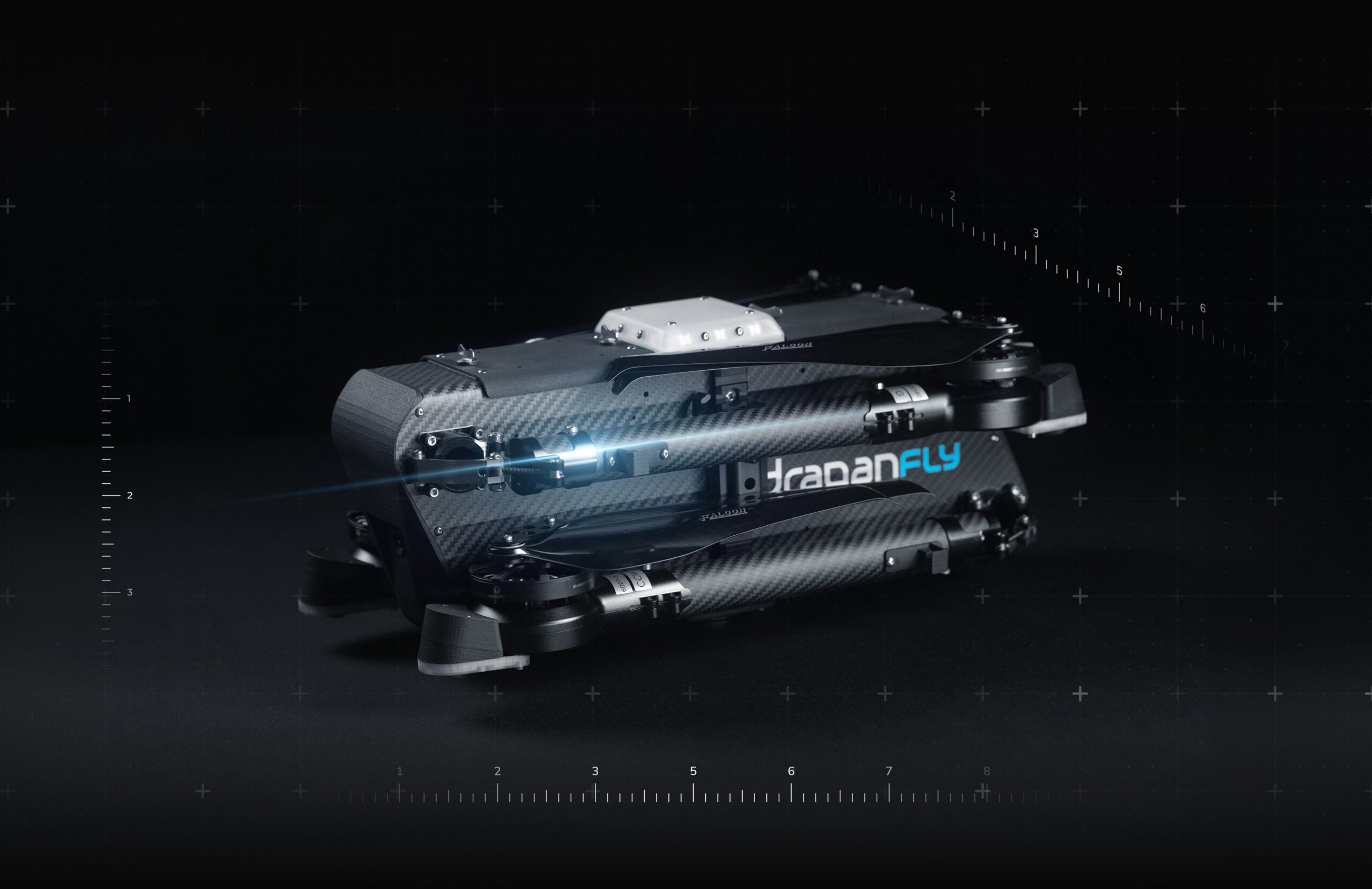
The Draganfly Apex is one of the few drones on this list with a direct Canadian connection. Manufactured in both Canada and the U.S., the Apex is a compact quadcopter specifically engineered for police and military missions. It offers up to 45 minutes of flight time with approximately 5 pounds of payload capacity. Modular, quick-release payload mounts make it straightforward to swap between thermal cameras, zoom optics, and other mission-specific sensors without tools.
For Canadian agencies looking to source domestic, the Apex is one of the strongest available options. It also meets U.S. NDAA requirements, which matters for cross-border joint operations and any federal grant conditions attached to equipment purchases.
Inspired Flight IF800 “Tomcat”
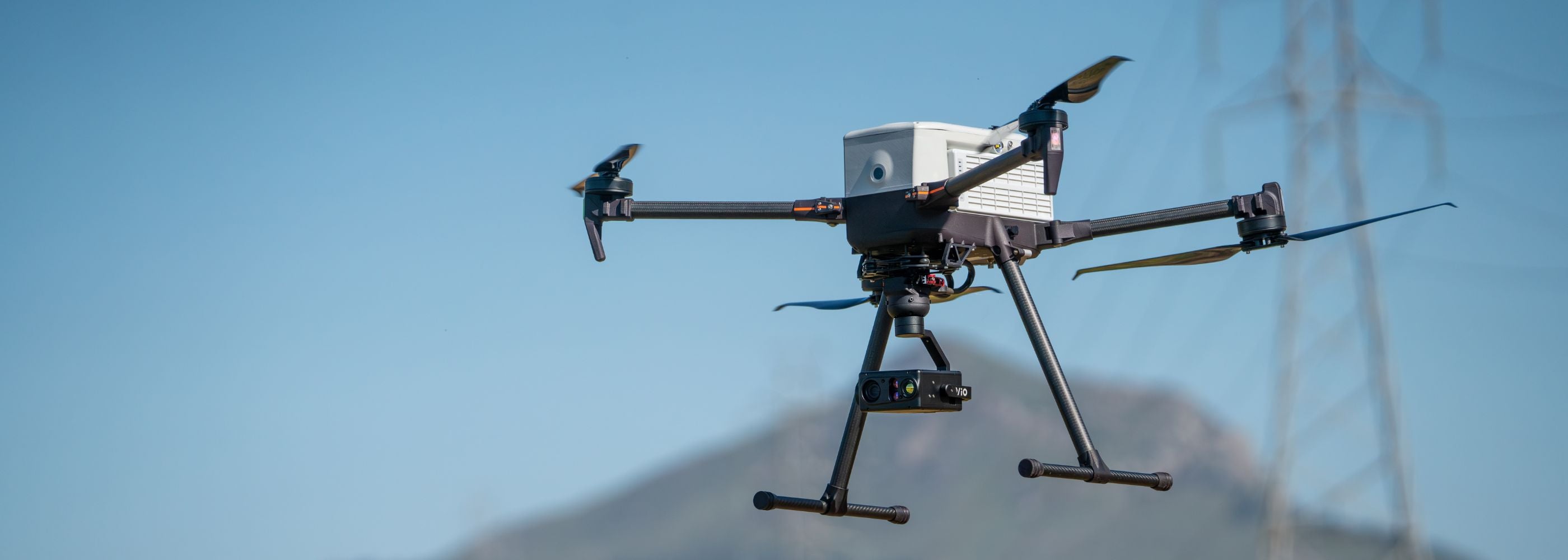
The Inspired Flight IF800 “Tomcat” is an American-made hexacopter built for demanding operational environments. It delivers over 50 minutes of flight endurance, uses a foldable design for rapid deployment, carries an IP43 weather rating for operation in rain and dust, and supports dual hot-swappable batteries for extended mission continuity without landing to recharge. Pricing starts around $23,000 CAD.

The platform is payload-agnostic, supporting high-resolution imaging, thermal sensors, and LiDAR systems through standard gimbal interfaces. For agencies that need a rugged, long-endurance workhorse, the IF800 is one of the best-performing platforms currently on the market outside of Chinese manufacturers.
Skydio X10 and X10D
Skydio is the most prominent U.S.-based drone manufacturer in the public safety space. The X10 features industry-leading AI-powered obstacle avoidance, swappable payload modules, and both thermal and zoom camera options in one platform. Flight endurance exceeds 40 minutes.
The X10D is the defense variant, fully NDAA-compliant and listed on the Blue UAS Cleared List. In March 2026, the U.S. Army ordered over 2,500 units — a signal of where the military and public safety market is heading. Real-world deployments include St. Cloud, Florida PD (roof-mounted Skydio docks with auto-launch) and Redmond and San Francisco PD, where Skydio drones are airborne in under 90 seconds to assist with active suspect intercepts.
Teal 2 (Red Cat)
The Teal 2 is a compact, rucksack-portable quadcopter built for short-range reconnaissance in constrained environments — indoor tactical work, stairwells, building entries. It uses a 640×480 FLIR thermal sensor, AI object tracking, and domestically sourced components. It is Blue UAS certified and has already been ordered by U.S. Customs and Border Protection (CBP) — 106 systems with thermal cameras.
Parrot ANAFI USA
French-manufactured, the ANAFI USA meets NDAA compliance requirements because it is produced outside of China by a Western manufacturer. The platform offers 32× zoom, a FLIR thermal camera, IP53 weatherproofing, and 32 minutes of flight time. It has been adopted by FEMA for training, and the ANAFI USA MIL variant is used by CBP, ICE, and the Secret Service. It is listed on the Blue UAS Cleared List.
Brinc LEMUR 2 — tactical indoor operations
The Brinc LEMUR 2 is purpose-built for situations where sending a person is too dangerous. It features a built-in glass breaker, thermal plus 4K cameras, two-way audio for negotiation or instructions, and LiDAR for indoor navigation without GPS. It is American-made and fully NDAA-compliant. Police Magazine references it specifically for surveilling “areas too dangerous to send a person” — active shooter scenes, barricaded suspect situations, and hazardous material incidents.
Advanced sensors: what you pair with the platform matters
Choosing a compliant airframe is only half the decision. The sensor payload determines what the drone can actually do on scene.
Sentera 65R — high-resolution imaging

The Sentera 65R captures 65-megapixel images at 0.45 cm/pixel ground resolution. For crime scene documentation, accident reconstruction, and forensic mapping, this level of detail means investigators can extract evidence-quality imagery from a single drone pass — reducing the time officers spend on scene and improving documentation quality.
GreenValley LiAir X3C-H LiDAR

The GreenValley LiAir X3C-H is a LiDAR system designed for forensic and structural mapping. LiDAR sees through light vegetation and captures precise 3D point clouds regardless of lighting conditions — critical for documenting crash sites, building structures, and terrain that standard cameras cannot capture accurately. It integrates with the IF800 and other compatible platforms in the compliant fleet.
Comparison: leading NDAA-compliant platforms at a glance
| Drone | Origin | Flight Time | Key Strength | Blue UAS |
|---|---|---|---|---|
| Draganfly Apex | Canada / USA | 45 min | Canadian-made, modular payloads | Yes |
| Inspired Flight IF800 | USA | 50+ min | Long endurance, IP43, hot-swap batteries | Yes |
| Skydio X10 / X10D | USA | 40+ min | AI obstacle avoidance, swappable payloads | Yes |
| Teal 2 (Red Cat) | USA | ~30 min | Compact, portable, FLIR thermal | Yes |
| Parrot ANAFI USA | France | 32 min | 32× zoom, FLIR, IP53, proven federal use | Yes |
| Brinc LEMUR 2 | USA | N/A | Tactical indoor, glass breaker, 2-way audio | Yes |
| Red Cat Edge 130 | USA | 125 min | Hybrid VTOL, 20 km range, EO/IR | Yes |
What Canadian agencies need to know right now
Canada does not yet have a nationwide equivalent to the U.S. NDAA drone restrictions. But that does not mean Canadian law enforcement agencies can ignore this trend. Several factors are pushing Canadian agencies in the same direction:
- Five Eyes intelligence sharing obligations — Canadian security agencies coordinate closely with U.S. counterparts. Operating equipment flagged by U.S. intelligence as a data security risk creates friction in joint operations.
- Federal procurement signals — Canadian federal government procurement is increasingly aligned with security guidelines that echo NDAA concerns. Agencies that receive federal grants or work under federal contracts may face conditions similar to U.S. rules.
- CSE and RCMP guidance — The Communications Security Establishment and RCMP have both issued guidance on cybersecurity risks from foreign-manufactured technology. Drones that transmit operational data are explicitly in scope.
- Future-proofing investment — Any agency buying drones today that expects to operate them for 5–7 years should be thinking about where regulations will be in 2030, not 2024.
Before purchasing any drone for public safety use, Canadian agencies should review the Blue UAS Cleared List and consult with their legal and procurement teams about any federal funding conditions attached to their budgets.
How SkyTech can help
At SkyTech, we work directly with public safety agencies, municipalities, and government departments across Canada. We supply DJI Enterprise platforms where they remain appropriate, and we can advise on NDAA-compliant alternatives when compliance requirements apply to your operation.
If your agency is mid-transition, evaluating compliant alternatives, or simply trying to understand what the regulatory landscape means for your next drone purchase, reach out to our team. We will give you a straight answer based on your operational needs, not a sales pitch.