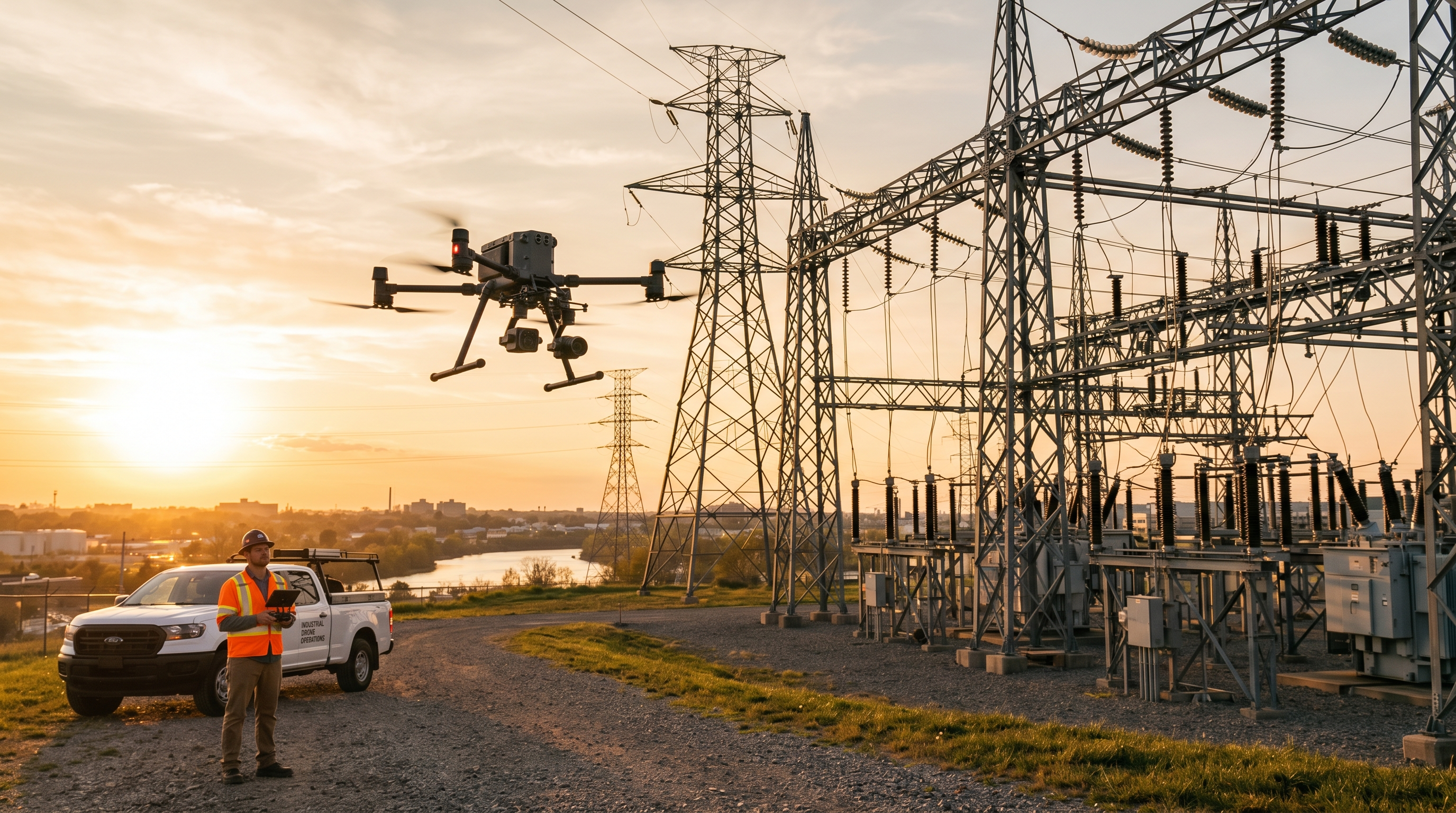
If you manage operations or HR at an energy company, here is the short answer. Any employee who flies a drone for work needs a valid Remotely Piloted Aircraft System (RPAS) pilot certificate from Transport Canada. For most utility and power infrastructure work, that means the Advanced certificate. Energy company drone operator certification Canada is not a nice-to-have. It is a legal requirement under the Canadian Aviation Regulations, and getting it wrong exposes your company to fines, grounded operations, and denied insurance claims.
This guide explains what certification involves, what it costs, and how to qualify a full team without pulling everyone off the job for weeks. If you already use drones for substation inspections, pipeline patrols, or solar farm surveys, proper certification turns an informal practice into a documented, audit-ready program. Many energy firms now fold this into their broader use of commercial drone services rather than treating it as a one-off.
What energy company drone operator certification Canada actually covers
In Canada, drone rules are set by Transport Canada and apply to any aircraft between 250 grams and 25 kilograms. Nearly every drone an energy company uses for inspection falls in this range. The DJI Matrice and Mavic Enterprise models common in utility work all require a certified pilot at the controls. There are two certificate levels, and the difference matters for your operation.
The Basic certificate covers simple operations. You fly in uncontrolled airspace, more than 30 metres from bystanders, and away from airports. The Advanced certificate covers controlled airspace, flights near people, and operations close to aerodromes. Power lines, substations, and many job sites sit in or near controlled airspace. So the energy company drone operator certification Canada actually requires is almost always the Advanced one.
You can read the current rules straight from Transport Canada’s drone safety pages. They are clear on one point. The pilot, not the company, holds the certificate. So your program needs enough certified staff to cover the work even when someone is on leave or moves to another role. Cross-training a few extra operators is cheap insurance against a single point of failure.
Why certification protects your bottom line
Operations managers weighing energy company drone operator certification Canada care about three things. Liability, compliance, and uptime. Certification touches all three.
On liability, an uncertified flight that causes property damage or injury is a serious problem. Your insurer can deny the claim because the operation broke federal regulations. The full cost then lands on your company. A documented certification program is your evidence that the operation was lawful.
On compliance, Transport Canada can issue fines up to 5,000 dollars for an individual and 25,000 dollars for a corporation per violation. Those penalties stack per offence, so a single bad day in the field can turn into a five-figure bill. For a regulated energy company already under audit pressure, an aviation infraction is a problem you do not need.
On uptime, a certified in-house crew inspects a substation or a wind turbine on your schedule, not a contractor’s. A job that once took a full crew and a bucket truck most of a day can take one certified pilot two hours. That is the real return. Faster inspections, fewer climbs, and less physical exposure for your people.
The cost of flying uncertified
Some teams fly first and certify later. That is a mistake. Beyond the fines, an incident involving an uncertified pilot can trigger a Transport Canada investigation that grounds your entire drone program while it runs. Weeks of lost inspection capability cost far more than the training ever would.
Basic vs Advanced drone operator certification for energy teams
Here is the honest breakdown. The Basic certificate is cheaper and faster. It needs a 35-question online exam with a 65 percent pass mark and no flight test. But Basic alone will not cover most energy work, because so much of it happens near infrastructure, roads, and controlled airspace.
The Advanced certificate requires a harder 50-question exam at 80 percent, plus an in-person flight review with a certified reviewer. It opens up the operations energy crews actually need. Flying in controlled airspace, operating closer to people, and supporting the complex jobs that sometimes need a Special Flight Operations Certificate. For nearly every utility, our advice is to put field staff straight through the Advanced path. You can see the full scope of advanced RPAS certification and match it against your typical job sites.
One more honest note. The flight review is where many self-taught pilots fail the first time. The written exam tests knowledge. The review tests whether someone can fly a planned mission safely. Structured training is the difference between a first-time pass and a costly retake that pulls staff off the job again.
How to roll out energy company drone operator certification Canada across a team
Certifying one hobbyist is easy. Certifying a field crew of eight while keeping the work moving is a logistics problem. This is where a corporate program earns its keep. Energy company drone operator certification Canada done at scale usually follows four steps.
First, assess who needs to fly and at what level. Not everyone needs Advanced, so map certification to roles. Second, run ground school as a group, ideally on-site, so your team trains together against your real job sites and equipment. Third, schedule flight reviews in batches so a reviewer comes to you instead of sending staff out one at a time. Fourth, build a recurrency plan, because pilots must stay current and renew their flight review every two years.
Group and on-site training options
This is exactly what we built our corporate programs to handle. Mostavio-SkyTech offers group training, on-site sessions at your facility, and custom programs shaped around your fleet and your sites. Training your team where they work, on the drones they actually fly, beats a generic classroom for retention. It also means your energy company drone operator certification Canada program reflects your real operating environment from day one, not a textbook version of it.
Building the ROI case for drone operator certification
If you need to justify the spend to finance, frame it in their language. Start with the labour math. A certified pilot finishing a transmission tower inspection in two hours replaces a half-day, multi-person manual effort that often needs a bucket truck or a climber. Across a full season of inspections, the saved hours and avoided equipment rentals add up quickly.
Then add risk reduction. Every flight your team performs in-house under a proper energy company drone operator certification Canada framework is a flight where liability is controlled and insurance stays valid. Compare that to the open-ended cost of a single denied claim or a regulatory fine.
Finally, factor in independence. Owning the capability means you are not waiting on a contractor’s calendar after a storm or an outage. When a transmission line needs eyes within hours, a certified internal crew is already on site while a third party is still booking the job. For a utility judged on restoration times, that speed is worth real money.
Where to start
The practical first move is an audit. List the drone work your company does or wants to do, identify who will fly, and decide how many Advanced certified pilots you need to cover it. Scoping energy company drone operator certification Canada this way keeps you from over-training staff who only need Basic. From there, a structured group program can qualify your team in weeks, not months, with far better first-attempt pass rates than self-study.
Done right, energy company drone operator certification Canada stops being a compliance box to tick and becomes an operational asset. Your inspections get faster, your liability shrinks, and your team owns a capability that pays back every season. If you want to scope a program for your crew, you can book a free consultation and we will map certification to your exact operations.
Ready to Take the Next Step?
Whether you need drone pilot certification, a custom engineered solution, help navigating Transport Canada permits, or a professional drone service for your next project, Mostavio-SkyTech is your trusted partner in Canada.
Contact us today for a free consultation and let’s build something great together.