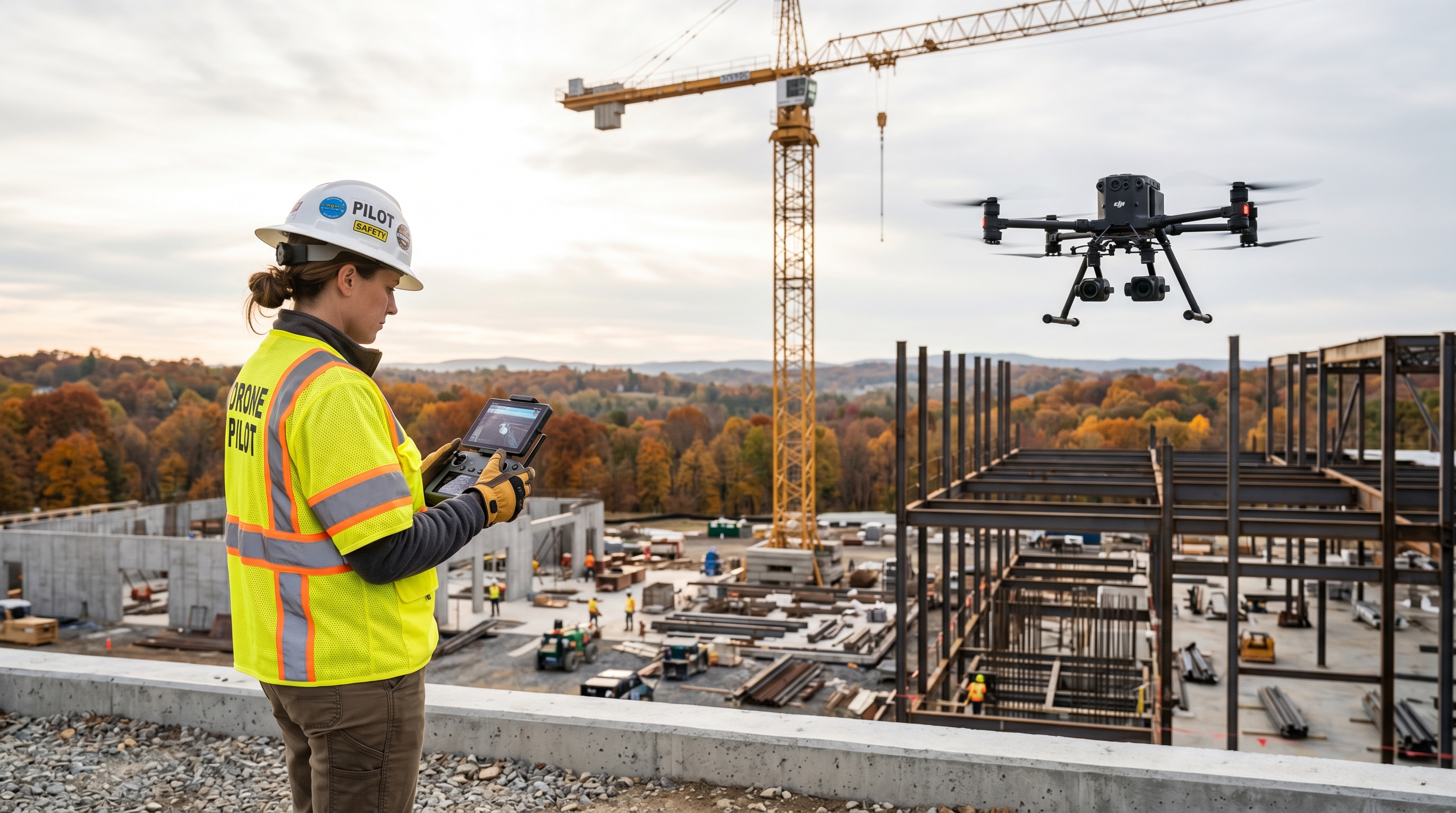
If your crews still rent a drone vendor for every site scan or, worse, fly without certification, training your own pilots is usually the cheaper and safer move. A construction company drone pilot training Canada program takes a site supervisor, surveyor, or safety officer and turns them into a legal, insured drone operator in a few weeks. For an operations or HR lead, the case is straightforward: lower liability, faster site data, and one fewer outside vendor to book. This guide covers what the training includes, what it costs, and how to roll it out across a crew without slowing down the job.
Why Construction Companies Are Training Their Own Pilots
Drones have quietly become standard equipment on Canadian job sites. They handle progress photos, volumetric stockpile measurements, topographic surveys, roof and facade inspections, and as-built documentation. The bottleneck is access. Hiring an external pilot for every flight means waiting on their schedule, paying day rates, and re-explaining your site to a stranger each visit.
Training in-house removes that friction. When a foreman or surveyor already on payroll can launch a drone before the morning huddle, you get same-day data instead of next-week deliverables. That is the core reason demand for construction company drone pilot training Canada has grown so fast. It is not about replacing professional commercial drone services for the complex jobs. It is about handling routine flights yourself and saving the specialists for work that genuinely needs them.
What Construction Company Drone Pilot Training Canada Covers
In Canada, almost any drone used on a commercial site falls under Transport Canada’s Remotely Piloted Aircraft System rules. Any aircraft between 250 grams and 25 kilograms requires a certified pilot. A solid construction company drone pilot training Canada course is built around getting your people through that certification, then flying safely once they pass.
Expect the curriculum to cover three areas:
- Ground school. Air law, airspace classification, weather, human factors, and reading aviation charts. This is what the Transport Canada exam tests.
- Hands-on flight training. Pre-flight checks, manual control, automated mapping missions, lost-link and emergency procedures, and site-specific risk planning.
- Compliance workflow. Registering aircraft, logging flights, checking airspace with the NAV Drone app, and keeping the records your insurer and Transport Canada expect.
Strong providers tailor the flight portion to construction. Your crew should practice the missions they will actually fly, such as a 40-acre topographic survey, a stockpile volume calculation, or a tower crane inspection. You can review the official certification requirements on the Transport Canada website before you commit to any program.
Basic vs Advanced: Matching the Certificate to the Job
Transport Canada issues two pilot certificates, and the difference matters on a job site.
The Basic certificate covers flights in uncontrolled airspace and more than 30 metres from bystanders. The exam is 35 questions with a 65 percent pass mark, and it costs about $10 to write online. It is enough for an open rural site far from any airport.
The Advanced certificate is the one most construction firms actually need. It allows flights in controlled airspace, near people, and closer to airports, which describes most urban and suburban sites. It requires a 50-question exam at an 80 percent pass mark plus an in-person flight review with a certified reviewer. A good Transport Canada drone pilot training provider will steer you to Advanced if any of your sites sit under controlled airspace, and will tell you honestly when Basic is enough, because over-certifying just wastes time and money.
The ROI Case for Construction Company Drone Pilot Training Canada
Operations managers do not buy training. They buy outcomes. Here is where construction company drone pilot training Canada earns back the investment.
Survey and mapping time. A drone can map 40 to 60 acres in a single flight and produce a survey-grade orthomosaic the same day. With RTK positioning, accuracy lands in the 1 to 3 centimetre range, close to what a ground crew delivers over several days. On a mid-size site, a weekly aerial survey can save a two-person crew most of a working day each time, and that adds up fast across a season.
Fewer truck rolls and vendor invoices. Every external drone booking carries a day rate, travel, and a deliverable delay. Bring those flights in-house and the recurring cost disappears once the training pays for itself, which usually happens within the first few projects.
Better progress tracking. Weekly aerial captures give project managers and owners a clear visual record. That speeds up payment draws, reduces disputes, and documents who did what and when.
None of this requires a large fleet. A single Advanced-certified pilot and one capable drone can serve several active sites.
Liability and Compliance: Where Construction Company Drone Pilot Training Canada Pays Off
This is the part that gets safety and HR leaders to sign off. Falls from height remain among the leading causes of serious injury on Canadian construction sites. Every roof, facade, or tower inspection a drone handles is one your people do not have to climb for. That is a direct reduction in your risk exposure.
Certification also protects you legally. Flying an uncertified drone on a commercial site risks Transport Canada penalties that reach into the thousands of dollars per violation, and an incident can void your coverage. Most commercial drone insurance policies require proof that your pilots hold the correct certificate. A documented construction company drone pilot training Canada program puts that proof on file and keeps your operation defensible.
There is a reputational angle too. General contractors and owners increasingly ask subcontractors about their drone protocols. Showing certified pilots and logged flights is becoming a quiet differentiator when you bid.
Group, On-Site, and Custom Corporate Programs
You do not have to send people away one at a time. SkyTech runs group sessions, on-site training at your yard or a live job site, and custom corporate programs built around your equipment and your typical missions. On-site training is often the best value for a construction firm, because the crew certifies on the same drones and the same sites they will use every week.
A typical rollout looks like this. Certify two or three pilots first, usually supervisors or surveyors, then write a simple internal standard for who flies, how flights get logged, and where the data goes. Equipment choice matters here too, and a good partner will walk you through DJI enterprise platforms such as the Mavic 3 Enterprise, which gives about 45 minutes of flight time and an optional RTK module for survey work. Start small, prove the value on one site, then expand.
Getting Started
For most Canadian construction firms, the question is no longer whether to use drones. It is whether to keep paying for them one flight at a time or build the capability in-house. A well-run construction company drone pilot training Canada program answers that by turning existing staff into certified pilots, cutting liability, and putting same-day site data in your project managers’ hands. The upfront cost is modest, and the payback shows up quickly on your survey, inspection, and vendor lines.
If you are weighing it for your team, the practical next step is to map your sites against airspace, decide how many Advanced pilots you need, and choose a provider that will train on your own equipment. SkyTech can help you scope all of that, and you can book a free consultation to design a program that fits your crews and your budget. Construction company drone pilot training Canada is one of the few investments in this trade that improves safety and the bottom line at the same time.
Ready to Take the Next Step?
Whether you need drone pilot certification, a custom engineered solution, help navigating Transport Canada permits, or a professional drone service for your next project, Mostavio-SkyTech is your trusted partner in Canada.
Contact us today for a free consultation and let’s build something great together.