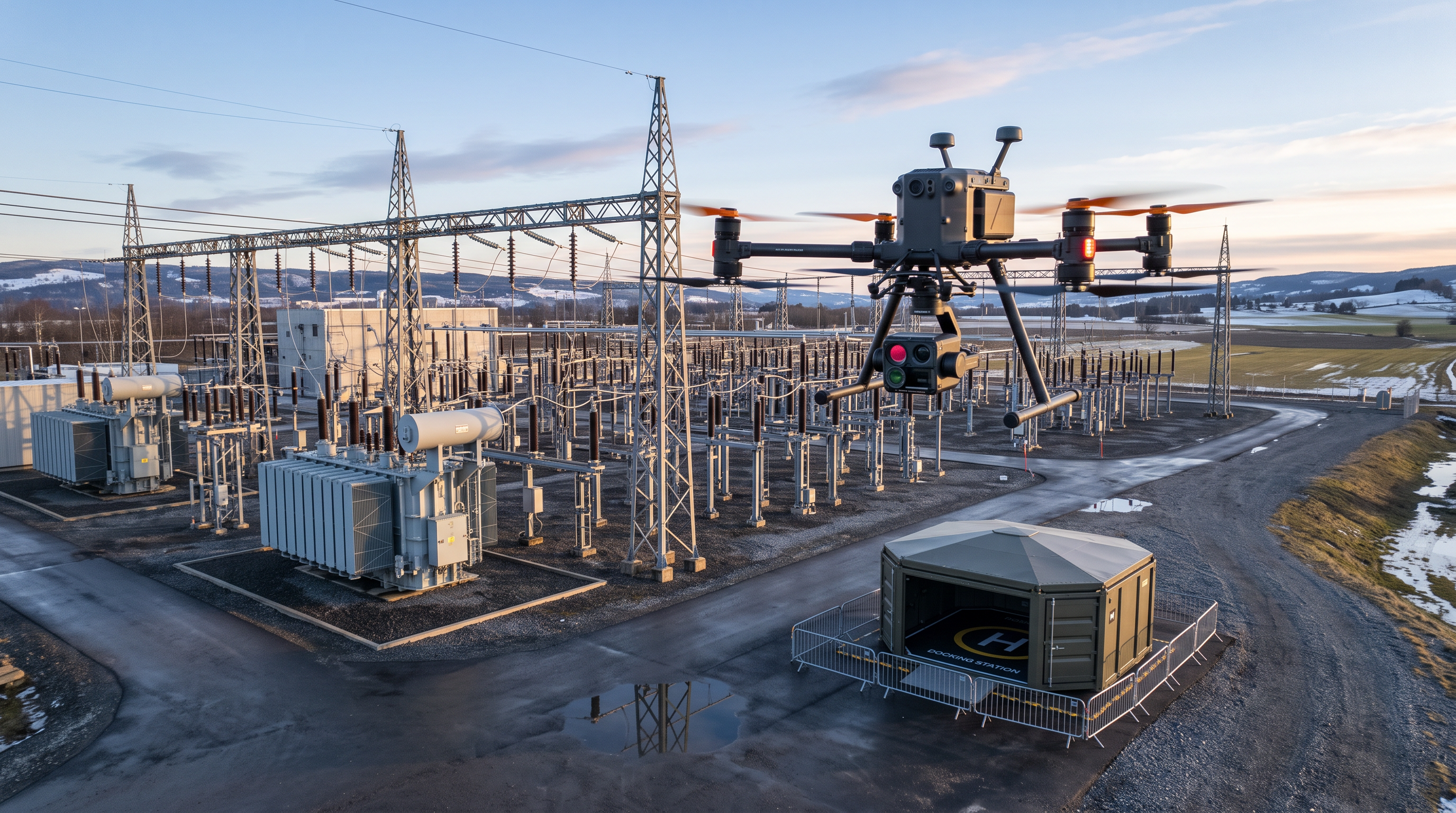
If off-the-shelf drones still haven’t solved your problem after two or three purchases, the drone was never the real issue. The system around it was. An automated drone fleet for industry Canada is not something you order from a catalogue. It is a system engineered around one site, one data problem, and the conditions your crews actually work in. Most vendors won’t tell you that, because a catalogue is all they sell.
Stock platforms from DJI and other makers handle most commercial jobs well. Something like 80% of routine inspection, mapping, and survey work needs nothing custom. The hard 20% is different: the sensor no manufacturer builds, the remote site with no cell signal, the inspection that has to run at 2 a.m. in January with no pilot on location. That gap is where an engineered fleet earns its keep, and it is the problem our engineering team at SkyTech is built to solve.
Why Stock Drones Hit a Wall
A commercial drone is a compromise built for the widest possible market. The payload bay fits the sensors the manufacturer sells. The software talks to the manufacturer’s cloud. The flight modes assume a pilot standing nearby with a controller. For most buyers that is fine, and honestly it is the cheaper path. Our standard commercial drone services cover that ground, and we will tell you when you don’t need anything more.
The wall shows up when your requirement falls outside that design. A few real examples:
- You need a methane sniffer and a 640×512 thermal camera on the same airframe, logging to your own database instead of a vendor portal.
- Your assets sit 40 km down a corridor with no road and no cell coverage, so a pilot on site is not practical.
- You want a defect flagged and a work order opened automatically, without an analyst reviewing 4,000 photos by hand.
- Your site runs around the clock and the inspection has to happen on a fixed schedule, in the dark, at minus 25.
None of those are drone problems. They are systems problems. Solving them is what separates a fleet you buy from a fleet you build.
What an Automated Drone Fleet for Industry Canada Actually Requires
An automated drone fleet for industry Canada is really five systems working together, and the aircraft is only one of them. You need an airframe matched to the payload, a base station or dock that charges and launches it, a communications link that survives poor coverage, a data pipeline that turns images into answers, and integration with the systems your team already uses. Miss one and the whole thing stalls.
Canada adds constraints that vendors in warmer, denser markets tend to ignore. Battery performance drops sharply below freezing, so a drone rated for 45 minutes might give you 30 at minus 20. Flying beyond visual line of sight (BVLOS), which is what makes a truly automated fleet worthwhile, needs an SFOC or an approval under the newer rules from Transport Canada. Distances between sites are large. Cell coverage outside the major-city corridors is thin. A design that works in a demo near Toronto can fail 300 km north, and we plan for that from the first drawing.
Payload Development, the Part Nobody Sells You
Payload is usually the reason a client calls us. The drone can fly. The real question is what it carries and what that sensor sees. A DJI Matrice 350 RTK, for example, carries about 2.7 kg. That is a hard budget you design against, and every gram of a custom mount is a gram of battery or sensor you give up.
Custom sensor integration
We integrate sensors the platform was never meant to hold: gas detectors, hyperspectral cameras, LiDAR units tuned for a specific point density, radiation meters, even custom RF gear. That work means designing the mount, managing power and data lines, rebalancing the airframe, and validating flight behaviour with the new weight and drag. A sensor that behaves on a bench can ruin flight stability if it is bolted on without that step.
Getting the data off the aircraft
A sensor is useless if its data lands in a format nobody can use. Part of payload work is the pipeline: onboard storage, in-flight streaming where bandwidth allows, and a clean handoff into your database or GIS. This is often where our custom drone engineering solutions save the most time, because the raw capture is already shaped for the tools your analysts use.
System Integration and AI Vision
An automated fleet is only as good as the software behind it. Two parts matter most: how the fleet plugs into your operation, and how much thinking the system does on its own.
Integration means the drone data does not sit in its own silo. We connect fleets to asset management systems, SCADA, and work-order platforms through their APIs, so a flagged corrosion spot becomes a maintenance ticket without anyone retyping it. For a utility or a mine, that link is the difference between a nice video and an operational tool.
AI vision is where the hours come back. A single BVLOS flight over a solar farm or a transmission line can produce thousands of frames. No one should review them by hand. Trained detection models can flag a cracked panel, a hot joint, or a leaning pole at accuracy above 95% for well-defined defects, then push only the exceptions to a person. Where that inference runs, on the aircraft, at the edge inside the dock, or in the cloud, depends on your bandwidth and how fast you need the answer. We size that per site instead of forcing one pattern on every client. How these models pair with DJI’s enterprise platforms shapes what is realistic on any given airframe.
Designing an Automated Drone Fleet for Industry Canada Around Your Site
There is no standard layout for an automated drone fleet for industry Canada, because there is no standard site. A pipeline right-of-way, a container terminal, and an open-pit mine each need different dock placement, different flight geometry, and different redundancy. Good design starts with your problem, not with a product sheet.
Our process usually runs in this order:
- Define the data outcome. What decision does this fleet inform, and how often? That sets everything downstream.
- Map the site and its constraints. Coverage area, no-fly zones, obstacles, weather windows, and power.
- Match airframe and payload to the job. Sometimes a stock Matrice with a custom mount is enough. Sometimes it is not.
- Plan the automation and the regulatory path. Dock locations, charging cycles, and the BVLOS approval that makes the whole operation legal.
- Integrate, then prove it. Connect to your systems and validate against a real work cycle before you depend on it.
This is deliberately unglamorous. An automated fleet that runs for three years without drama is worth far more than a flashy demo that quits on the first cold morning.
What It Costs to Run an Automated Drone Fleet for Industry Canada
Be honest about budget before you start. A custom automated drone fleet for industry Canada is not cheap, and it should not be your first move. If a trained pilot with a stock drone solves the problem, that is what we will recommend, and it will cost a fraction of an engineered system.
Custom earns its price when the numbers are large and they repeat. If manual inspection ties up a crew for 200 hours a month, or one missed defect risks a six-figure failure, the math shifts fast. An automated drone fleet for industry Canada that runs on a schedule can cut inspection labour by half or more and catch problems earlier, which is usually where the real return sits. We would rather scope that honestly up front than sell you hardware you cannot justify.
Where to Start
Start with the problem, written down in plain terms, before you look at any aircraft. What decision do you need, how often, and what does getting it wrong cost you today? With that in hand, an automated drone fleet for industry Canada stops being an abstract idea and becomes a scoped engineering project with a clear payback. For most clients the smartest first step is a short feasibility review, which costs far less than a pilot program that guessed wrong.
Our engineering team has built payloads, docks, and vision pipelines for sites that stock drones could not serve. If that sounds like your problem, book a free consultation and we will tell you honestly whether a custom fleet is the right call or whether something simpler will do.
Ready to Take the Next Step?
Whether you need drone pilot certification, a custom engineered solution, help navigating Transport Canada permits, or a professional drone service for your next project, Mostavio-SkyTech is your trusted partner in Canada.
Contact us today for a free consultation and let’s build something great together.