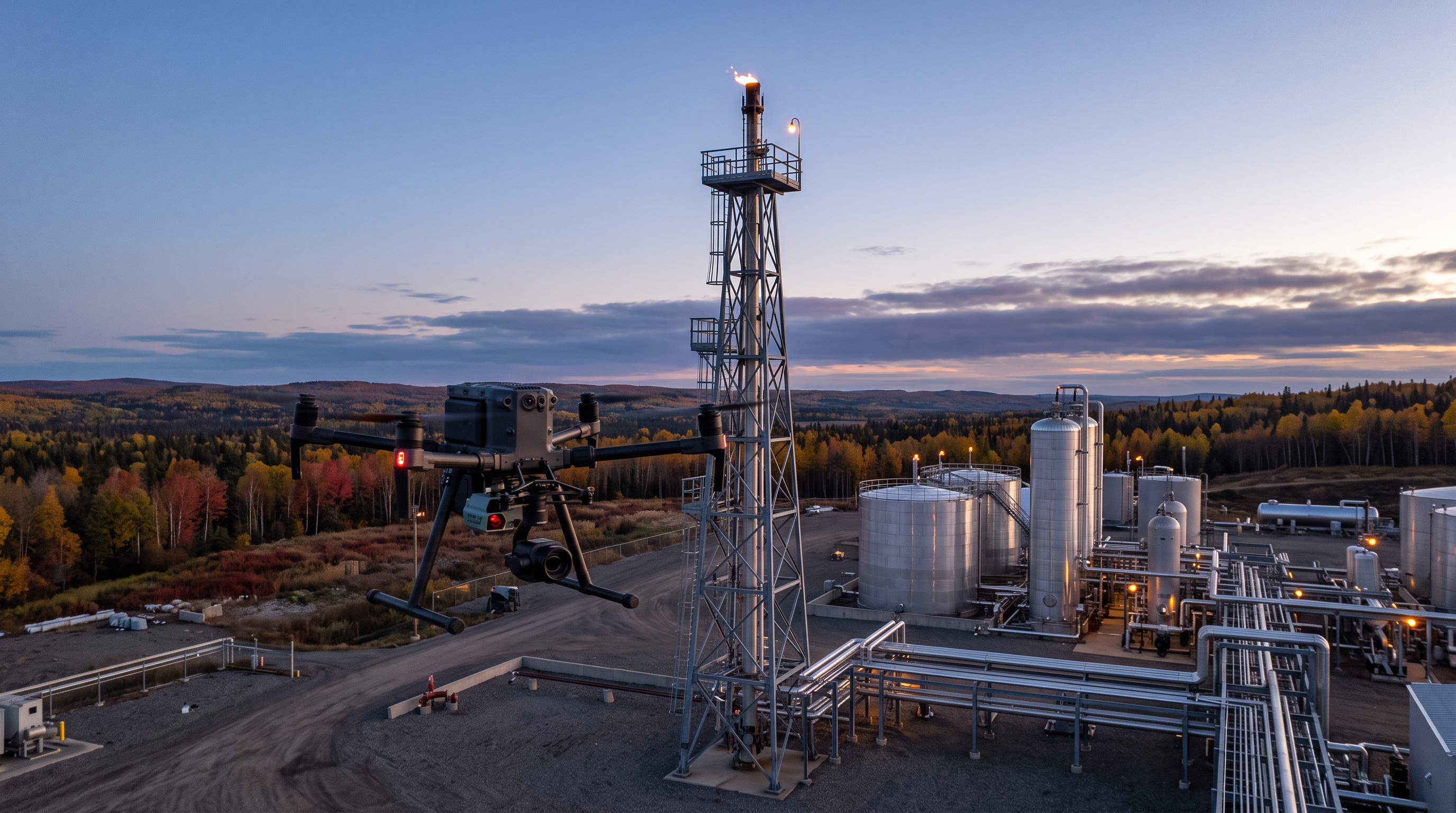
If your team keeps trying to force an off-the-shelf drone to do a job it was never built for, the honest answer is that you probably need custom UAV integration for oil and gas Canada work, not another aircraft from a catalog. Custom integration means building the airframe, the payload, the software, and the ground workflow around one specific problem. A methane survey a stock camera cannot see. A wellpad patrol that runs without a pilot on site. A data pipeline that drops clean numbers into your asset management system before the morning shift.
Off-the-shelf enterprise drones are very good at general work. They map, they inspect, they carry a solid thermal camera. But upstream and midstream sites throw edge cases a general platform will never handle well. That gap is where custom UAV integration for oil and gas Canada starts to earn its keep, and it is where our engineering team spends most of its time.
When Off-the-Shelf Drones Hit Their Limit
Most operators start with a stock platform because it is fast to buy and easy to fly. That is the right call for photo work, stockpile volumes, and basic thermal scans. The trouble shows up when the mission gets specific. A standard payload bay will not take a laser methane sensor and a gas sniffer at the same time. A stock aircraft will not fly a 14 km pipeline right-of-way beyond visual line of sight without an approval and a detect-and-avoid plan. And a general data app will not tag a corroded flange, geo-reference it to 3 cm, and push a work order into your maintenance system.
Manufacturers like DJI Enterprise build excellent general-purpose airframes, and we sell and fly them every week through our commercial drone services. The point is not that these drones are weak. The point is that a facility with sour gas, flare stacks, and a 24/7 uptime target has requirements no mass-market product will ever list on a spec sheet. When the standard tool stops matching the job, you either accept worse data or you build the tool that fits.
What Custom UAV Integration for Oil and Gas Canada Actually Involves
People hear “custom drone” and picture a hobbyist gluing a sensor to a frame. Real custom UAV integration for oil and gas Canada is a systems job. It has four parts that have to work as one: the payload, the airframe and autonomy stack, the AI vision and data layer, and the ground operation that keeps it all legal and repeatable. We build those together, because a sensor that reads perfectly but cannot be flown safely, or data that is accurate but never reaches your engineers, solves nothing.
Payload Development
Payload is usually where the real problem lives. For a methane program we integrate a tunable diode laser sensor that reads down to single-digit ppm-m and log it against GPS, so a leak becomes a map pin instead of a guess. For asset inspection we pair a 45x zoom optical camera with a radiometric thermal core, so an inspector can read a bolt temperature from 40 m out. Payload weight drives everything else. A 2.5 kg integrated sensor block cuts endurance, so we size the airframe and battery around the real payload, not a brochure number. Honest tradeoff: a heavy custom payload often means 25 to 35 minutes of flight instead of the 40-plus you see on a bare aircraft. We plan missions around that real number.
System Integration and Autonomy
The second layer is making the aircraft fly the mission by itself. That means RTK positioning for 2 to 3 cm repeatability, so this month’s tank scan lines up with last month’s. It means programmed corridor flights for pipeline and powerline patrol. And it means return-to-home logic tuned for a site full of steel structures that confuse a compass. This is the engineering-heavy part, and it is the core of our custom drone engineering solutions practice.
AI Vision and Data
Raw images are not the deliverable. Answers are. We train computer-vision models to flag what your team actually cares about: a corrosion bloom on a tank seam, vegetation creeping onto a right-of-way, a hot spot on a transformer, a methane plume above a set threshold. A model that auto-sorts 4,000 inspection frames down to the 30 that need a human eye turns a two-day review into an afternoon. That is the real return, and it only works when payload, flight, and software are designed together.
Designing an Automated Fleet That Runs Itself
For large sites, a single piloted drone is not the endgame. The endgame is a drone-in-a-box: an aircraft that lives in a weatherproof dock on the pad, launches on a schedule or an alarm, flies its route, lands, recharges, and uploads. One dock can run several inspections a day with no crew on site. For a remote facility where a truck roll costs hundreds of dollars and half a day, that changes the math fast. Automated fleet design is a natural extension of custom UAV integration for oil and gas Canada, because the dock, the network, and the flight rules all have to be engineered for your exact site and airspace.
Fleet work also forces the boring but critical questions. Where does the data go? Who gets the alert at 2 a.m.? What happens when LTE drops in the field? We answer those in the design phase, not after something fails. A fleet that produces data nobody can act on is just an expensive way to fill a hard drive.
Regulation Shapes Custom UAV Integration for Oil and Gas Canada
Here is the part that catches most in-house projects off guard. In Canada, the aircraft is the easy bit. The approval is the hard bit. Any serious custom UAV integration for oil and gas Canada program lives or dies on beyond-visual-line-of-sight (BVLOS) authorization, because pipeline and facility work only makes economic sense when one operator can cover long distances or run an uncrewed dock. That path runs through Transport Canada, and the rules keep moving.
You have to match your operation to current requirements for pilot certification, aircraft registration, and site-specific approvals. Always verify the latest at Transport Canada, and build the compliance case in parallel with the hardware, not after it. We have taken teams through advanced RPAS operations and BVLOS applications, so we design the airframe and the paperwork to support each other. A brilliant custom drone you are not allowed to fly is a paperweight.
What It Costs and What You Get Back
Custom work is not cheap, and pretending otherwise wastes everyone’s time. A custom payload and autonomy program runs well above the price of a stock aircraft, and a docked fleet is a bigger commitment again. So the question is never “what does the drone cost.” It is “what does the current method cost, and what does this replace.” Custom UAV integration for oil and gas Canada usually competes against helicopter patrols, rope-access crews, or sending people into confined and classified spaces. Against those numbers, a system that inspects a flare stack in 20 minutes instead of a full shutdown, or surveys 15 km of line without a truck, pays back quickly and takes people out of harm’s way at the same time.
Where to Start With Custom UAV Integration for Oil and Gas Canada
Start with the problem, not the drone. Write down the one job that off-the-shelf gear cannot do, the data you wish you had, and what a good answer would let you decide. That single page is worth more than any spec sheet. From there, a scoping conversation sorts out whether the fix is a custom payload, a full autonomous fleet, or a smarter use of a platform you already own. We will tell you honestly when a stock drone is enough, because selling you engineering you do not need is a bad way to keep a client.
If standard drones keep failing at the same job, that is the right time to talk. You can book a free consultation with our engineering team, walk us through the site and the mission, and get a straight assessment of what custom UAV integration for oil and gas Canada would take, what it would cost, and whether it is the right move at all. The best programs start with one honest problem and one honest conversation.
Ready to Take the Next Step?
Whether you need drone pilot certification, a custom engineered solution, help navigating Transport Canada permits, or a professional drone service for your next project, Mostavio-SkyTech is your trusted partner in Canada.
Contact us today for a free consultation and let’s build something great together.