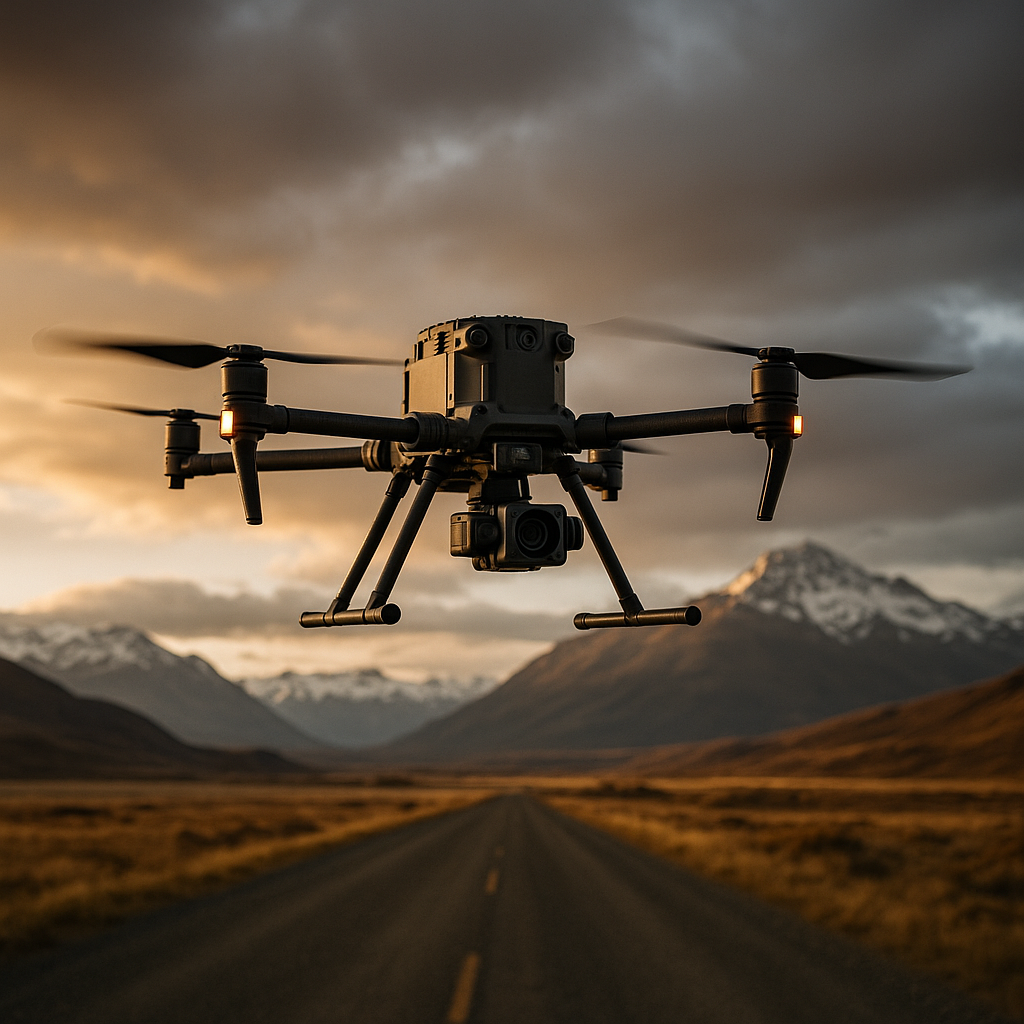
If you’re wondering how to choose a commercial drone Canada, start with the mission you need to accomplish and the environment you have to fly in. From there, pick the smallest, safest airframe that reliably delivers the data quality your stakeholders require. In Canada, that usually means shortlisting a DJI Mavic 3 Enterprise for survey-grade mapping, a Matrice 30T for mobile inspection and public safety, or a Matrice 350 RTK for heavy sensors like LiDAR and multi-sensor gimbals. As a DJI Enterprise dealer and operators ourselves, our team at Mostavio-SkyTech has flown these platforms on construction, utilities, public safety, and environmental jobs across the country—and we’ll help you match the right tool to the job.
How to choose a commercial drone Canada: start with the mission
Before you look at spec sheets, define exactly what “success” looks like for your operation. Use this quick framework:
- Deliverable: Orthomosaic, 3D model, thermal inspection, LiDAR point cloud, high-zoom documentation, or multispectral analytics.
- Accuracy and resolution: Centimetre-grade survey vs. qualitative inspection vs. radiometric thermal detail.
- Operating conditions: Wind, cold, precipitation, night work, EMI sources, launch/land footprints.
- Tempo and logistics: One-person rapid response vs. planned multi-crew data collection.
- Compliance and risk: Altitudes, proximity to people and critical infrastructure, controlled airspace, redundancy needs.
- Budget and lifecycle: Airframe, sensors, batteries, chargers, storage, software, maintenance, and training.
That mission profile dictates which DJI Enterprise class you should consider—and is the fastest, most reliable approach to how to choose a commercial drone Canada.
If you’re not sure how to articulate your mission profile, our operations team can help you scope it, model ROI, and even execute pilot projects under our commercial drone services umbrella before you buy.
How to choose a commercial drone Canada for mapping and surveying
Best fit: DJI Mavic 3 Enterprise (M3E) or Matrice 350 RTK with Zenmuse P1/L2
- Mavic 3 Enterprise (M3E): A compact mapping workhorse with a 20 MP 4/3” sensor and mechanical shutter for distortion-free images. Add the RTK module for centimetre-level geotagging and efficient corridor mapping. Typical flight times near the 40+ minute mark let one pilot cover large areas with fewer battery swaps. This is the “smallest tool that gets the job done” for construction progress, stockpile volumes, and topo mapping.
- Matrice 350 RTK + Zenmuse P1: When you need the highest-fidelity photogrammetry, the full-frame, 45 MP P1 on the M350 RTK produces exceptional GSD and image quality. The airframe’s endurance, stability, and multi-battery ecosystem shine on large sites.
- Matrice 350 RTK + Zenmuse L2 LiDAR: For vegetated or complex sites, LiDAR is often faster and less sensitive to lighting. The L2 combines a high-accuracy IMU and GNSS for dense, precise point clouds—ideal for earthworks, utilities, and forestry. Process both photogrammetry and LiDAR outputs in tools like Pix4D to deliver survey-grade results with proper control.
When your core question is how to choose a commercial drone Canada for mapping, start with the required ground sampling distance (GSD) and total acreage. If a 20 MP, 4/3” sensor at safe altitude meets your specs, the M3E minimizes cost and complexity. If not, step up to the P1 or L2 on the M350 RTK.
How to choose a commercial drone Canada for inspections and public safety
Best fit: DJI Matrice 30 Series (M30/M30T) or Matrice 350 RTK with H20T/H20N
- Matrice 30T: Compact, quick to deploy, and weather-resistant, the M30T combines a wide camera, a high-zoom sensor, a laser rangefinder, and a radiometric 640×512 thermal camera in one gimbal—perfect for line patrol, substation checks, building envelope inspections, and search and rescue. It’s a popular “first on scene” enterprise platform because it packs into a small case but handles wind and light precipitation with confidence.
- Matrice 350 RTK + H20T/H20N: For longer jobs, heavier winds, and multi-sensor redundancy, the M350 with H20-series payloads adds endurance and flexibility. You can hot-swap batteries, carry additional payloads (e.g., loudspeakers, beacons), and integrate with advanced workflows like dual-operator control.
If your team needs to fly in tough weather, at night, or around critical infrastructure, the question of how to choose a commercial drone Canada usually comes down to IP rating, sensor mix, and redundancy. The M30T is the go-to for mobility; the M350 is the platform for sustained, high-risk operations.
How to choose a commercial drone Canada for agriculture and environment
Best fit: DJI Mavic 3 Multispectral (M3M) or Matrice 350 RTK with LiDAR/Multispectral
- Mavic 3 Multispectral (M3M): Purpose-built for vegetation analysis, the M3M pairs a 20 MP RGB camera with four multispectral bands to produce NDVI and related indices. It’s efficient, compact, and integrates with precision agriculture platforms.
- M350 RTK + L2 or specialized sensors: For forestry, habitat modelling, and terrain analysis under canopy, LiDAR on an M350 creates accurate elevation models and stem maps that photogrammetry alone cannot match.
In this domain, how to choose a commercial drone Canada means optimizing for spectral quality, repeatable flight plans, and data pipelines that agronomists and environmental scientists can trust.
How to choose a commercial drone Canada: specs that matter in real operations
Experience has taught us that a few specs consistently separate successful fleets from expensive shelfware:
- RTK positioning: For mapping and precision inspection, RTK reduces geotag error to centimetre-scale when configured correctly and/or paired with ground control. DJI Enterprise platforms support built-in RTK or add-on modules, streamlining setup across sites.
- Shutter type: Mechanical shutters prevent rolling distortion in mapping. That’s why the M3E and P1 are staples for survey-grade photogrammetry.
- Sensor fusion: Multi-sensor gimbals (zoom + wide + thermal + rangefinder) collapse multiple sorties into one. The M30T and H20-series payloads are standouts here.
- Weather resistance and redundancy: IP ratings and dual-battery architectures improve safety margins. The M30 series offers a strong mobility-weather balance; the M350 adds hot-swappable batteries and expanded redundancy for mission-critical tasks.
- Flight time vs. payload: Real-world endurance depends on temperature, wind, and weight. Match your platform to your typical payload and climate, not just the brochure number.
- Workflow compatibility: Ensure your data is easy to process in your chosen stack (e.g., Pix4D, Trimble Business Center, or industry GIS). DJI’s enterprise ecosystem is well covered by leading software vendors and offers a mature SDK for integration.
For a deeper dive into current airframes, sensors, and the DJI SDK ecosystem, see DJI’s official enterprise portal at dji.com/enterprise.
Canadian realities: climate, logistics, and compliance
A “Canada-proof” drone is one that still performs after 10 minutes on a frigid road shoulder in January or on a windy causeway in October. When you evaluate how to choose a commercial drone Canada, consider:
- Cold weather: Pre-warm batteries, keep spares insulated, and budget extra packs (capacity dips in cold). Dual-battery platforms with hot-swap minimize downtime.
- Wind: Choose an airframe with proven stability and control authority. The M30 series punches above its size class; the M350 is the most stable sub-25 kg DJI platform in gusty conditions.
- Footprint and mobility: If you’re hopping between rooftops or remote access roads, the pack-and-go M3E or M30T often out-produces larger systems simply by flying more often.
- Controlled airspace and ops over people: Many jobs brush up against airports, heliports, or populated areas. Pick platforms, procedures, and training that let you operate lawfully and confidently. Our team can help plan missions and provide pilots under our commercial drone services if needed.
Platform-by-platform: Quick guidance from the field
- Mavic 3 Enterprise (M3E): Best value for mapping and general documentation. Small footprint, mechanical shutter, RTK option. If you’re a construction PM wanting progress maps and as-builts without a full survey crew, this is the answer nine times out of ten.
- Mavic 3 Thermal (M3T): All the mobility of M3E plus radiometric thermal. Great for building envelope scanning, quick utility diagnostics, and public safety overwatch—when you want thermal without the heavier Matrice footprint.
- Mavic 3 Multispectral (M3M): Efficient NDVI and multispectral analytics for agriculture and vegetation management. It’s the most practical entry to precision ag imaging.
- Matrice 30/M30T: The “always in the truck” inspection platform. IP-rated, multi-sensor, quick deploy. If your use-case spans everything from rooftops to riverbanks, the M30T is a proven middle ground.
- Matrice 350 RTK: The enterprise flagship for heavy sensors, night ops, complex inspections, and survey-grade capture. Pair it with the P1, L2 LiDAR, or H20-series payloads for a complete capability stack.
- Dock-enabled operations (DJI Dock 2 + Matrice 3D/3TD): For fixed sites and recurring tasks, a dock can eliminate travel and enable automated, scheduled flights. It’s not for every use-case, but where justified, the ROI is compelling.
Ownership math: batteries, payloads, software, and people
Buying the right airframe is half the battle. The rest is operational reality:
- Batteries and charging: Budget at least 4–6 batteries for high-tempo work, plus a hub/charger that matches your field rhythm.
- Storage and transport: Rugged cases, SD card hygiene, and secure data workflows are essential for enterprise scale.
- Payload roadmap: If you’ll need thermal, LiDAR, or specialized optics within 12–18 months, pick a platform with the right gimbal ecosystem now.
- Training and SOPs: Consistent data quality comes from repeatable procedures. We help teams standardize flight plans, overlaps, camera settings, and RTK/GCP practices for reliable outcomes.
- Support and spares: Keep props, batteries, and at least one backup aircraft for critical operations. Downtime costs more than spares.
How to choose a commercial drone Canada: a decision tree you can trust
Use this quick path the next time someone asks how to choose a commercial drone Canada:
- Need survey-grade mapping under tight budgets? Mavic 3 Enterprise with RTK.
- Need thermal, zoom, and weather resistance in a compact kit? Matrice 30T.
- Need the highest-end mapping or LiDAR, extended endurance, and redundancy? Matrice 350 RTK with P1 or L2.
- Need multispectral analytics fast? Mavic 3 Multispectral.
- Need persistent or remote operations? Look at DJI Dock 2 and compatible aircraft.
If two options seem viable, we’ll help you run a side-by-side pilot. You can even book a free consultation to evaluate sample datasets and total cost of ownership against your exact deliverables.
Procurement confidence with an authorized partner
Enterprise purchasing is about lifecycle value, not just the sticker price. As a Toronto-based DJI Enterprise dealer and national operator, we provide:
- Pre-sale scoping and demos: Mission analysis, sample datasets, and side-by-side comparisons.
- Fleet configuration: Batteries, chargers, payloads, redundancy, and data workflows tailored to your operations.
- Onboarding and training: We align camera settings, RTK/GCP procedures, and QC checks with your mapping or inspection standards.
- Service and support: Firmware management, maintenance planning, and rapid spares.
- Operational augmentation: When you’re at capacity, our team can deliver the job under our commercial drone services, ensuring continuity.
Your next step: explore kits and get hands-on
By now, you’ve seen how to choose a commercial drone Canada comes down to matching mission, data quality, and environment to a proven airframe. Browse our curated DJI enterprise drone products to see recommended kits for mapping, inspection, public safety, and environmental work. We can also arrange demos and provide sample datasets so you can validate accuracy, coverage, and workflow in your own environment.
For deeper technical specs and official resources on platforms like Mavic 3 Enterprise, Matrice 30 Series, Matrice 350 RTK, and DJI Dock 2, DJI’s enterprise site maintains current documentation at dji.com/enterprise.
How to choose a commercial drone Canada: putting it all together with SkyTech
When the stakes are high—tight project schedules, safety-critical assets, or strict QA—choosing the right platform is simpler with a partner that flies these missions every week. At Mostavio-SkyTech, we help organizations de-risk their purchase by aligning deliverables, accuracy targets, and operating conditions with the smallest practical DJI Enterprise solution. We back that with training, SOPs, and support so your first project isn’t a science experiment.
Final thoughts: how to choose a commercial drone Canada
If you only remember one thing, make it this: start from the deliverable and the environment, then pick the smallest platform that consistently meets your accuracy and safety needs. That is the proven path for how to choose a commercial drone Canada, whether you’re mapping a subdivision, scanning a substation, or supporting public safety. And if you’d like guidance, we’re here to help you evaluate options, run a field trial, and stand up a program that scales.
Ready to Take the Next Step?
Whether you need drone pilot certification, a custom engineered
solution, help navigating Transport Canada permits, or a professional
drone service for your next project — Mostavio-SkyTech is your
trusted partner in Canada.
Contact us today for a free consultation
and let’s build something great together.